


 Meet Jay
Most folks come dragging in to work on Monday morning, but you look wide awake and ready to go. Is that for real?
Quite real! Because I am in my True Calling™ I have the opportunity to use my skills, passions and strengths to do exactly what I want to do which is to advance people's careers. This sounds like an advertisement for our company, but I'm sincere. Whether it is a Monday or a Tuesday or a Saturday, every day is a holiday.
I am energized today, but that hasn't always been the case. In my previous job, there were days when I woke up dreading the knowledge that I was going to put 10 to 12 hours into something that I didn't really enjoy. I would come home at night drained. Even days that I had off were still spent in a state of anxiety, just trying to catch up and get ready for the next work week.
Now waking up in the morning is easy to do. This morning I ran five miles. It gives me a chance to think and get ready for the day ahead. By the time I get back, my blood is pumping, especially this morning in the crisp fall air. I am refreshed, focused, wide awake and ready to go. I have already accomplished something. I have breakfast, read the paper, and see my wife off to work.
Then I get to come in to our office and work with clients. Today I drove into work whistling; other drivers on the parkway looked at me like I was crazy! It doesn't mean I work any less; the work is intense and sometimes involves long hours. But I go home energized.
Going through this program with Nathan four years ago allowed me to enjoy life again, not spend 20 or 30 years doing something just because I made good money that I had to wait for the golden years to enjoy. Now I'd like to help the rest of the world feel that way!
It's clear your passion today is helping others find their True Calling™. Did you grow up knowing what you wanted to do?
I always wanted to work in business. I wanted to wear a suit and tie and work in a high rise because I equated those things with success but beyond that, no.
I was always geared toward sports, and I was always very competitive. I wanted to be the best at what I did. Athletically I excelled; academically I was average which was good enough for me at the time.
My father worked in Aerospace Engineering, and my mother was a Teacher before dedicating herself to her children . I came from a family where everyone went to college, so I always knew that was in my future. Like a lot of people in our culture, I went through high school concentrating on where I would go to college. Once in college, my focus was to graduate from college. After that, I figured I would go to work to make a living.
How did you get from a general interest in achieving and a love of sports to your current passion for career development?
It was a lot like running hurdles, which I did in high school.
( If you want to jump directly to Jay's career story, click here.)
I was born and raised in the Largo, Florida area. My family always loved Colorado, and we took our vacations there every year. When I was in high school, we moved to Colorado. I received a scholarship to run track for Adams State College, a small college in southern Colorado .
I ran hurdles, and I ran because I loved to run. Sports helped to focus me in junior high and high school. I knew I had to perform at a certain level to play, and I learned a lot about teamwork and discipline.
But athletics is a business in college, especially when you're there on full scholarship. It became a chore-working out for two hours each morning, attending daily meetings, and running for a couple of hours every afternoon.
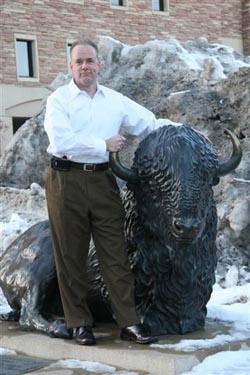 I gave it a year, and then I transferred to the University of Colorado (CU) in Boulder. I loved Boulder , and I had attended Boulder High School. CU was right up the street, and I had always wanted to go there.
I received my undergraduate degree in Arts and Science with majors in political science and history. During my final year at CU, I completed an exciting internship with the Denver Museum of Nature and Science to bring a major international exhibit from Egypt to the United States.
I spent six weeks in Egypt organizing and detailing the exhibit. I planned to join the Special Projects team as a full-time member, but the Gulf War broke out. Egypt shut down the transfer of everything related to Egyptian artifacts and therefore, my opportunity.
It's certainly a shift from ancient Egypt to human resources. Describe that career path.
I took a position as a management trainee. I didn't know anything about the industry, but I was wearing a suit and tie. That job did not work out, so after a year I went to another company thinking that changing the industry would solve the problem. It didn't.
Life had bitten me, and at that point I was pretty lost. Two positions in two years, and I still didn't really know what I wanted to do. I ended up applying for an evening shift at the downtown Hyatt Hotel so I could spend my days looking for a career opportunity.
I worked very hard in my position at the Hyatt because that's my nature. Hyatt invited me to join their management training program, and at that point-two to three years into my career-I found the career opportunity I was looking for and began to focus.
Hyatt's program provides trainees the opportunity to experience each and every department, division and position over the course of a year. What a great way to learn the industry as part of a multi-million dollar, four-star hotel chain. I worked everywhere from finance to culinary arts to human resources (HR). I discovered an interest in HR, and upon completion of the program I was promoted to Employment Manager.
My HR experience with Hyatt Hotels & Resorts lasted for ten years. In those ten years I held a variety of positions with increasing responsibility, including Employment Manager, Benefits and Employee Relations Manager, Assistant Director and Director of Human Resources. I moved to two different cities, including San Antonio, Texas and Seattle, Washington. I like HR, and the travel was an adventure for my wife and me.
But after a while, we needed to come back to Denver. Our family and friends were here, and my wife's mother was terminally ill. Hyatt transferred me to a position as HR Director at the Hyatt Regency Tech Center where I knew I would spend a couple of years and then move to another position in Chicago.
Although the years with Hyatt were good, and I gained valuable career and life experience, I knew it was time to move on. In the hotel industry and in my position, you're on 365 days a year, with frequent moves. I also knew that HR by itself was not the answer. Something just wasn't right about it.
I thought changing industries was the way to go. In 2001, I joined Equity Office Properties as a Regional Human Resource Manager. I went from face-to-face HR management to HR consulting. As a Regional HR Director with responsibility for multiple states, I traveled frequently, working with the HR Managers. Something was still missing in this new position, but before I could figure out what it was, I was laid off.
This was the most traumatic career experience of my life even though it was primarily due to economic conditions.
Part of my severance package included outplacement services. I was fortunate that I was assigned to a gifted career specialist, Nathan Teegarden. I worked with Nathan on finding my True Calling™. Since I had an HR background and experience in recruiting, I worked simultaneously on getting back into the HR field.
Interestingly enough, I found my True Calling™: career development. To me it was a natural extension from HR into career development. Over the next year, Nathan worked with me to help me re-tool for my new industry. He became a mentor and a friend. Since we both held the same passion for career development and the same ethical beliefs, he invited me to join his team.
Since you knew your True Calling™ by this time, was it an easy decision to join Nathan at the Center for Career Advancement (now Dymimus)?
As a matter of fact, no it was not. In parallel to my work with Nathan, I had continued the job search, and my efforts had paid off: I was offered a big position with an insurance company as Regional VP of HR. The job came with a huge salary, large bonus and significant benefits.
I was weighing two competing paths: a familiar corporate position or my True Calling™. Should I take the unknown road or the one with the security and benefits? I felt a lot of pressure to take the high paid corporate position. The other road seemed dark, bleak and unknown.
I decided to take the corporate position and put career development on the shelf. I am an all-or-nothing kind of guy, so in reality I knew that career development would stay on the shelf for a long time once I started my new position.
Literally the morning before I was to start with the insurance company, I woke up at 2 a.m. I knew I was taking the wrong path. I made a very difficult call to a very confused VP that morning to let him know that I would not be coming on board.
Then I called Nathan, and here I am.
Ever looked back and wondered about that decision?
Absolutely! Even post-decision there were times when I wondered if I'd done the right thing. There weren't a lot of people patting me on the back at the time.
There were times of anxiety, particularly early on. Before this I worked for Fortune 500 companies, so entrepreneurship was new to me. But I've found that I can use my past, especially that decision, to help others move through their fears and anxieties.
Sometimes finding out what you were meant to do can be scary. The bigger challenge isn't placing someone in a job; it is helping them believe in what they are meant to do.
Did you do any specific preparation for your new career, or did you just jump right in?
My personality is all or none. I didn't have a bridge job or a fallback. I don't encourage that approach for everyone, but it worked in my circumstances.
My Fulfillment process wasn't typical. We found out early on that career development was going to be an area of interest, so I did some research. Actually, I visited every Denver metropolitan area company that specializes in career development from the multi-million dollar companies to one person consultants. By the time I made my decision, I had researched the industry thoroughly and knew what I was getting into.
I brought a lot of training and experience to the table from my HR background, and I did obtain some certifications, specifically in the use of the MBTI and in coaching. Much of my preparation came through the Center for Career Advancement (CCA), which is what we were called at the time.
I shadowed Nathan when he worked with clients, and he worked with me when I did one-on-ones. We actually created the Career Specialist training program during this time so that future career specialists could benefit from a structured process.
The training program addresses the career specialist part. In addition, I learned how to grow and run a business-everything from branding to advertising to managing. I'm not only working with clients; I'm building a business. I never thought I could do this, but I've set out on a whole new direction.
What do you tell people when they ask what you do today?
First off, I tell them I'm a problem solver. When people ask me what that means, I tell them I help people with their careers. I use the term "problem solver" because most people come in thinking their career is a problem. They see that it's draining their relationships with their family and friends.
I help people find their career focus, their True Calling™, by taking clients through a series of assessments and intellectual discussions. I do that by using our methodology, but we don't use a cookie cutter approach. People are unique, and their Discovery processes are tailored to fit their circumstances. Then I work with them to get them placed into what they should be doing from a career standpoint.
In a general sense, I could say I do career development, but it could be career enhancement or career transition. My recognition comes from advancing other people's careers and seeing the smiles on their faces.
Did you learn anything new about yourself during your own Discovery process? Any surprises?
I had a huge amount of information about myself, being in HR and having been through many assessments. I knew everything from what type of animal I am to what type of color I am!
Our assessments were highly accurate, right on target. But unlike some of the assessments I'd taken, we use and apply the information. The idea of building on your strengths rather than improving your weaknesses was new. Knowing my strengths, knowing how my strengths affect my attitudes, knowing how I process information and knowing how I make decisions-this information allowed me to focus on maximizing my potential rather than just being average.
And the idea of having a passion and going after it was new, too. If you can't hit the ten-ringer, hit the eight-ring. If you go for what you know you should be doing, you'll be closer to where you want to wind up.
How do you use this knowledge of your strengths?
Part of the Discovery process includes creating a Personal Profile. People won't necessarily understand what it means that I am a Myers-Briggs ISTJ, but they will understand that I love being around people and that I'm very structured, very detailed. I'm very much a thinker in my decision making process. I make decisions very quickly, with closure, once I have all the facts. I'm organized and efficient, and once I decide to act, I like to move quickly and get results.
Understanding my preferences helps me know myself, and knowing others' preferences and personality profiles helps us avoid unnecessary conflict.
Do you have time for anything outside of work?
 That's one of the benefits of being in my True Calling™. I enjoy a full, balanced life now rather than waiting for the golden years. I'm married to a wonderful, supportive woman. I love sports, both as a participant and a spectator. I'm an avid CU Buffs fan. Going to CU football games is a social event for me. I can share the time with my wife, my family or friends while watching a game.
I don't run hurdles anymore, but running is a part of my day. I'm a recreational runner who does a few races here and there. I'd dropped any kind of exercise when I was in the corporate work world and paid the price. I was carrying an extra 35 pounds and a lot of stress that I've lost since I started running again four years ago. I also enjoy hiking and playing racquetball.
I love to study history. I read a lot of history. I watch the History Channel. Right now I'm very interested in the way history has played a part in the events unfolding today.
My parents instilled in me a love of wines. They're very knowledgeable about wines, and it's a common ground. I can pair the right wine with any meal or make a wine selection sure to gather family members, and that's about the level I'd like to keep it.
What career advice would give to someone going through a career transition?
For the majority of us, our careers will last for at least 40 years. Don't worry about the material things. Instead focus on what you can do for the next 40 years that will keep you happy and engaged in life. You can randomly go out and try to find a job that interests you, but only about 10% of all people fall into something they enjoy.
First and foremost, determine the direction you want to head. Find as much information as you can to back up your direction. And look at why you want to do what you want to do. Use a process like our Discovery process.
Someone that's been in a career for a long period of time has felt what life has to offer. It can be rough it can be beautiful; usually it's both. You can build on that. Those folks are usually more open to pursuing their passions because they've experienced what it's like when you're just in a job.
But to change direction after 15 or 20 years is really difficult. Many people are concerned that they will put themselves so far behind financially and even from a satisfaction or status standpoint. It's a delicate process, especially at mid-life. It's not just about that one individual for most people at this stage of their lives. They have kids, mortgages and other responsibilities. You have to be realistic. Sometimes all that's needed is to make some adjustments to an existing career path. Other times, like in my own case, a bigger change is needed.
Sometimes we can't see our passions and our strengths because we're too close to them. We don't appreciate the gifts we have. And if people are having a hard time figuring it out on their own, that's where we can help. We always find that career focus - that True Calling™. Our Discovery process includes a money back guarantee; that's how confident we are.
Do you have a favorite book?
I'm currently reading a history of Tutankhamen. It contains good life lessons about who you should trust and who you shouldn't, even within your own family.
A magnificent book that really talks to what we do here at Dymimus is The Power of Full Engagement: Managing Energy, Not Time, Is the Key to High Performance and Personal Renewal by Jim Loehr and Tony Schwartz.
It talks about every aspect of every life.
Anyone from history that inspired you along the journey to your True Calling™? Who would you most like to meet?
In terms of U.S. history, probably Benjamin Franklin would be the person would have liked to meet. I would like to meet some of the early framers of the Constitution like Washington and Jefferson. I would ask them if their vision for the United States is anything like what we have now.
Where do you see yourself in 20 years; still in career development?
I really want to see Dynimus impact thousands and thousands of people worldwide and become a household name. I'd love to be there when it gets that large. It would be very exciting.
Peace of mind is the important thing at this stage of my life-living out my life with family and good friends, good health. Maybe I'll have a little satellite office in Boulder .
I will continue to work hard, and I hope to reap the financial rewards that frequently come with hard work in your True Calling™. But my real rewards come from advancing other's careers, and I see that continuing over 20 years or even more.
Top of Page
 Wit and Wisdom